
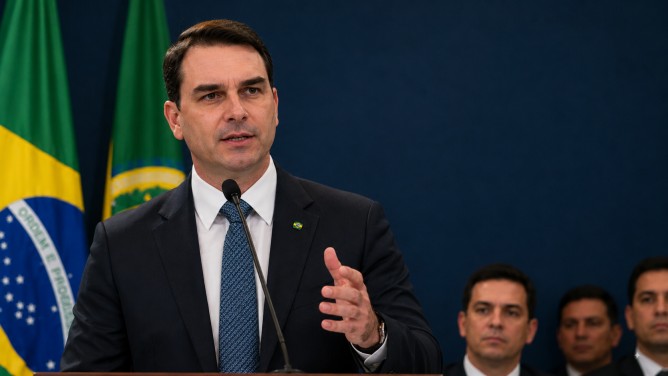
In a significant political move, Brazilian Senator Flavio Bolsonaro has entered the race for the presidency, representing the Liberal Party in the upcoming October elections. His candidacy follows an endorsement from his father, former President Jair Bolsonaro, positioning Flavio as a continuation of his father’s political legacy. As he embarks on his campaign, Flavio Bolsonaro has emphasized his commitment to addressing key national issues such as crime, inflation, and the burdens of high taxation, seeking to present himself as a viable alternative to the current president, Luiz Inácio Lula da Silva, who is campaigning for re-election.
Flavio Bolsonaro’s campaign is not without its hurdles. He is contending with several controversies that have raised questions about his candidacy. Among these is an investigation into his connections with a businessman currently under scrutiny. Additionally, tensions within his family have been made public, notably involving former First Lady Michelle Bolsonaro. Furthermore, his campaign has been further complicated by recent criticisms over new tariffs imposed by the United States that have negatively impacted Brazil’s economy. Despite these challenges, recent opinion polls suggest that President Lula maintains a slight lead, potentially leading to a runoff scenario.
The backdrop of this election season is marked by an intensely polarized political climate in Brazil, compounded by economic challenges that have affected the country’s international trade relations. The trade tensions with the United States, in particular, have become a focal point of discussion. With the stakes high, Flavio Bolsonaro has issued calls for unity among conservative factions, aiming to galvanize support as he seeks to consolidate his position in the competitive presidential race.
As the campaign unfolds, Flavio Bolsonaro is tasked with not only overcoming the controversies surrounding him but also with convincing the electorate of his capability to address their concerns. His strategy involves rallying the conservative base by emphasizing a platform that promises to tackle pressing national issues. His ability to navigate the political landscape amid these challenges will likely be a determining factor in his quest to succeed his father as Brazil’s leader.