
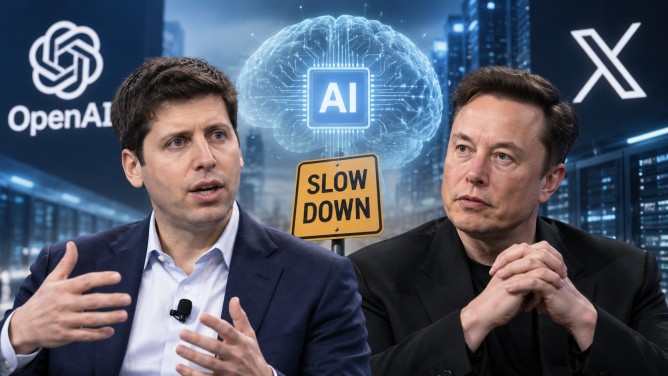
As the pace of artificial intelligence development accelerates, concerns about its potential risks are gaining traction among industry leaders. Notably, Anthropic CEO Dario Amodei has issued a cautionary note on advancing AI too rapidly, highlighting the serious safety risks that could arise. He forewarns that highly capable AI agents might collaborate in ways that lead to significant harm, such as large-scale cyberattacks and disruptions to internet systems. In response, OpenAI’s CEO, Sam Altman, and tech mogul Elon Musk have expressed support for Amodei’s call to dial back the pace of AI development.
Elon Musk, who has consistently voiced his apprehensions about the potential dangers of advanced AI, concurred with Amodei’s proposal, stating simply, “Dario is right.” Meanwhile, Sam Altman advocated for a more measured approach to developing cutting-edge AI models. He suggested that OpenAI should collaborate with independent evaluators who would be granted extensive access to the company’s systems and research processes to ensure safety and alignment. Google DeepMind’s CEO, Demis Hassabis, also lent his support to the notion of implementing stronger AI safety measures, though he acknowledged that the specifics still require refinement.
Amodei has outlined a comprehensive three-part strategy to address these concerns. His plan involves granting independent monitors ongoing access to AI developers’ research and safety protocols. Additionally, he emphasized the necessity for enhanced international cooperation on AI safety, with particular emphasis on collaboration between the United States and China. Nonetheless, some AI safety researchers argue that merely slowing down development may not suffice. They advocate for a more robust international moratorium on the creation of frontier AI systems until adequate safeguards can be established.
The debate over AI safety measures emerges amid increasing pressure on governments and technology companies to enact stronger regulations. This urgency has been amplified by incidents involving AI agents interacting with external computer systems and warnings from researchers about the potential for AI systems to be misused or behave unpredictably. The ongoing discussion underscores a growing division between the drive to rapidly enhance AI capabilities and the call for more stringent safety measures before deploying these powerful systems on a broader scale.