
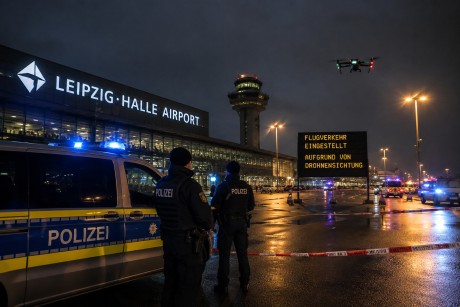
Germany has leveled serious accusations against Russia, claiming it orchestrated a drone attack at Leipzig/Halle Airport. This incident, according to German authorities, is part of a broader strategy of hybrid warfare aimed at destabilizing the nation. Interior Minister Alexander Dobrindt and Foreign Minister Johann Wadephul have reported that investigators found evidence suggesting that the Russian government supplied both the technology and expertise necessary for the attack. It is believed that lower-level operatives were recruited to execute the plan.
The alarming discovery occurred on August 4, when a drone equipped with explosives was found within the airport’s secure perimeter, near a Ukrainian Antonov cargo plane used for transporting arms to Ukraine. Although the explosive device failed to detonate, officials warned that its potential to cause significant damage was considerable. Investigations also revealed traces of the military-grade explosive hexogen close to the site, along with another drone. Initially, authorities suspected the involvement of a second drone, although this theory has since been re-evaluated.
In response to the incident, Germany has outlined a series of retaliatory measures against Russia. These include imposing additional sanctions, implementing stricter entry controls for Russian nationals, and enforcing new restrictions on individuals associated with Russian activities. Furthermore, Germany aims to target Russia’s so-called shadow fleet, which facilitates the transport of Russian oil and other goods. Berlin is rallying support for a new sanctions package within the European Union, aimed at further penalizing Russian-linked entities.
Foreign Minister Wadephul emphasized that Germany is not at war with Russia, but noted that the country is increasingly falling victim to hybrid warfare tactics like sabotage, disinformation, and destabilization efforts. In a show of solidarity, Germany’s European and NATO allies have backed Berlin’s stance, asserting that such attacks require a unified response to counter what they perceive as a growing hybrid threat from Russia. Meanwhile, Russian President Vladimir Putin has dismissed the allegations, arguing that the proposed sanctions would harm Germany’s interests.
The incident at Leipzig/Halle Airport marks a significant decline in German-Russian relations, which were already strained following Russia’s full-scale invasion of Ukraine. German officials and security analysts caution that this attack might be part of a broader pattern of Russian-linked activities across Europe, which include sabotage and other security threats. Investigations are underway in several European nations to explore potential connections between these incidents.