
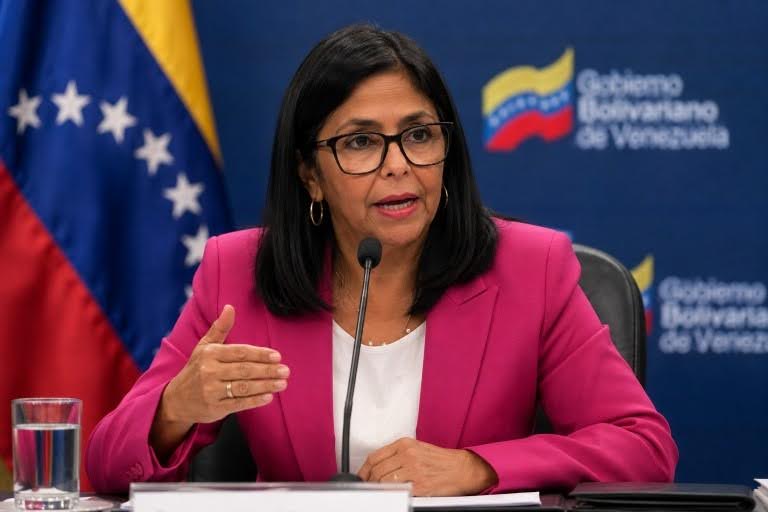
Delcy Rodríguez, Venezuela’s interim president, is standing firm in defense of a contentious energy deal with the United States, asserting that Venezuela’s ownership and control over its oil assets remain intact, despite significant domestic dissent. Rodríguez, who assumed leadership following the ousting of Maduro in a U.S.-led operation earlier this year, addressed the Venezuelan public to refute claims that she is relinquishing national resources to American interests. She highlighted the agreement’s potential to significantly boost the economy, predicting revenues upwards of $209 billion, and envisioning Venezuela’s transformation into a leading energy producer. According to Rodríguez, without necessary investments, technology, and infrastructure, the country’s vast oil reserves cannot be effectively harnessed for the benefit of its people.
The deal, which reportedly took shape through secret negotiations over several months, would grant the U.S. substantial access to Venezuela’s crude reserves, which are the largest proven in the world—surpassing those of Saudi Arabia and Iran. Rodríguez revealed that the agreement encompasses 17 key oilfields, aiming for a production capacity exceeding 1.5 million barrels per day.
The announcement has sparked a storm of criticism from opposition parties and even from within Rodríguez’s own political sphere. Critics perceive the deal as a blatant appropriation of resources, with a former executive from the state oil company condemning it as a betrayal of the country’s sovereignty. Public protests erupted in Caracas, with demonstrators decrying what they see as foreign intrusion, while social media voices sarcastically suggested a new name for the national oil enterprise.
This development represents a significant shift for Rodríguez and her political faction, historically opposed to foreign dominance over Venezuela’s natural wealth. Rodríguez herself has previously spoken against such agreements, making this deal a notable departure from her past positions.
Opposition figures express apprehension that this agreement might hinder the path to restoring democratic practices in Venezuela, raising questions about the timing of future elections. They argue that true economic progress hinges on transparent governance and free elections, warning that without these, the agreement may rest on an unstable base.